

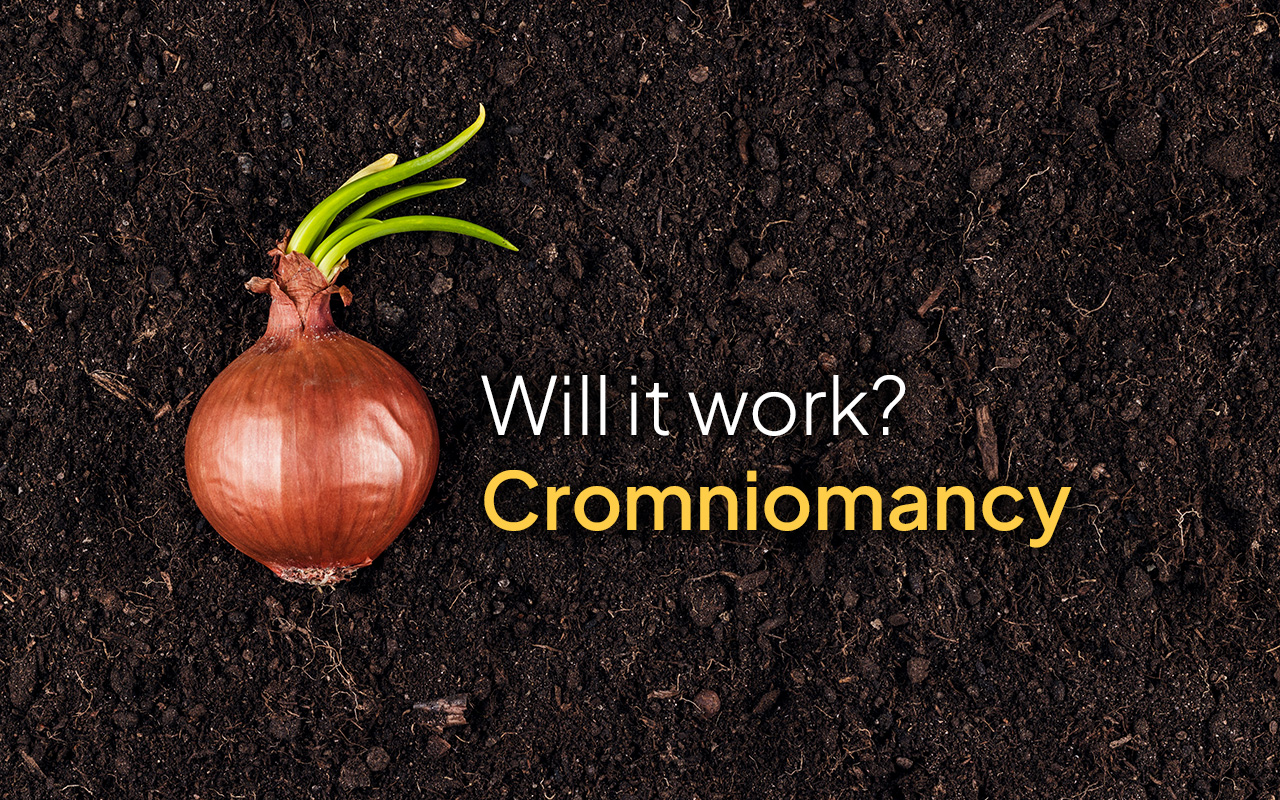
I recently considered hiring a high-priced strategy coach to help me navigate the ever-shifting Motivational Speaking industry, but I’ve decided to go in a different direction. I’m taking up cromniomancy.
For the uninitiated—and I assume that is most of you—this is the ancient and noble art of interpreting the sprouting pattern of an onion to predict what lies ahead. It sounds absurd, doesn’t it? But honestly, in a world evolving at such remarkable speeds, staring at a rooted vegetable feels as scientifically rigorous as any McKinsey Roadmap. If the vegetable is right, I’m a genius; if it’s wrong, I’ll make soup.
And yet many business leaders I work with still seem obsessed with “what” tomorrow may bring. I believe their energy may be better spent focussing on “who” they may need to become.Cromniomancy
The “Proven” Methods of Divination
With Big Data and “predictive analytics”, you’d think we might have moved past ancient superstitions. But in an era where the entire global economy can shift in a morning, is a complex computer model that much more reliable than tasseography (the curious art of reading tea leaves in the bottom of a cup)?
If you’re currently paying a futurist a small fortune to guess what 2030 may look like, you might save a few pounds by considering these equally “proven” alternatives:
- Tyromancy: Telling the future by examining the holes and patterns in cheese. (perfect for a charcuterie board meeting).
- Gyromancy: Spinning a person around until they dizzily fall down on a circle of letters. The resulting “word” becomes your Q4 strategy.
- Dictiomancy: Opening a dictionary at random and pointing to a word. (many corporate mission statements are written this way).
- Ptarmoscopy: Interpreting the hidden meaning behind a sneeze. (Bless you! But also put all your money on Mane Attraction in the 2.30pm at Chepstow).
- Scatomancy: This involves examining… er, excrement. Enough said. Enjoy your lunch.
Life Beyond the Crystal Ball
The temptation to reach for the tea leaves or a complex predictive algorithm is understandable. We crave certainty. We want to “future-proof” our lives, our careers, and our companies.
But “future-proofing” is a myth. It’s an outdated concept that suggests there’s a point of “completion” where we and our lives are safe from change. If 2026 has taught us anything, it’s that trying to future-proof a business is about as effective as Abocomancy—predicting the future by analysing patterns in dust.
This is the new reality: Futurism and long-range predictions have never held less value. So, instead of searching for certainty (or monitoring which way my onion will sprout), I’ve abandoned all hopes of “Future Certainty” in pursuit of higher levels of Future-Readiness.
Why Future-Readiness is the Antidote
While futurism looks outward at a world we cannot control, a Future-Ready-Mindset looks inward at the skills and capabilities we can control. It is the ultimate antidote to change fatigue because it replaces frantic “reactions” with continuous “readiness.”
Here’s how it helps:
- It’s an Ongoing Process: Unlike a one-off “strategy,” Future-Readying is a continuous, never-ending activity. It’s a constant state of personal evolution and growth.
- It Replaces Anxiety with Agility: When you stop obsessing over what will happen, you can focus on how to develop into the person who will know how to respond.
- It Abandons the Illusion of Certainty: There is immense freedom in admitting we don’t know what’s coming. When you stop trying to “solve” the future, you can start shaping it.
There’s an old saying that “the best way to predict the future is to create it.” While I love that sentiment, I prefer a more practical version:
The best way to predict the future is to be ready for it—no matter which version of it actually shows up at your door.
From Onions to Readiness
By all means, keep a bag of onions handy—but perhaps save them for a nice risotto rather than your next quarterly board meeting. The era of the “all-knowing” prediction is over, and frankly, we should be relieved. When we stop trying to “future-proof” our lives with plans that shatter at the first sign of a global shift, we find something much more resilient: the ability to adapt, evolve, and thrive regardless of the forecast.
Building a Future-Ready-Mindset isn’t about having the answers; it’s about being the kind of person (or organisation) who can handle whatever question the world throws your way next.
If you’re tired of the “future-proofing” clichés and want to explore how a Future-Ready-Mindset can help your team move from change fatigue to genuine agility, I’d love to hear from you.
Whether you want to book a keynote that’s a little more insightful than a sneeze-reading, or you’re looking for a strategy that actually works in 2026, let’s talk:
No onions required.